


When Ilvars Kirmuška left Latvia, he did not intend to stay abroad for long. He wanted a change, new experiences and an opportunity to see what life was like elsewhere. He took a gap year from his studies and left with the idea of staying for one year. But life took a different turn, and Ilvars ended up spending a total of 17 years abroad.
London came first, followed by a job offer that took him to Scotland. There, Ilvars gradually established himself in the construction industry. He initially worked as an employee, later became self-employed and eventually set up his own company. Over the years, he built a stable business, earned the trust of his clients and provided jobs for other Latvians as well.
“Basically, all the Latvians who lived in that town worked for me,” he recalls.
His story with Lāsma also began in Latvia, but their family life continued in Scotland. Lāsma left her life and job in Latvia to join Ilvars. Their two children were born in Scotland, where they built their family life and continued developing the business. From the outside, everything might have seemed settled, so why change anything?
Yet the thought of Latvia never disappeared.
Returning Was Not a Decision Made Overnight
The Kirmuška family visited Latvia regularly, and Ilvars says that each time they returned, the changes in their home country became more noticeable.
“At first, when we came back, we had mixed feelings, but in recent years we could see that people seemed happier and everything was becoming more pleasant. We saw that many things were changing for the better.”
However, deciding to move back did not simply mean packing their belongings, locking the door and leaving. Ilvars had a company in Scotland, employees, clients and ongoing construction projects. The life he had built there had to be brought to a close gradually.
The process took around two years. His employees were informed well in advance about the planned move, and Ilvars even offered one of them the opportunity to take over the company. No one was ready to do so.
“I told all my employees a year in advance that we were planning to leave. If anyone wanted to take over, I said we could sit down and discuss it. But not everyone is brave enough to take on that kind of responsibility.”
The United Kingdom’s withdrawal from the European Union also made the return more complicated. The family had to work out how to bring the tools and machinery accumulated over the years back to Latvia, deal with customs requirements and move their entire household.
For the children, meanwhile, it meant leaving the environment in which they had been born and raised. Ilvars admits that, for their sake, perhaps the family should have returned a little earlier, before they reached their teenage years. For the parents, Latvia meant returning home, while for the children it was also a move to a country they had previously known mainly through family visits.
Today, the situation is very different. They have friends, school and their own everyday life in Latvia.
Returning and Starting Again
Entrepreneurship was nothing new to Ilvars, but after returning to Latvia, he chose not simply to continue doing the same work he had done for years in Scotland. Instead, he decided to develop a business in earthworks.
Business support for returnees in Limbaži Municipality provided an important boost. With this support, Ilvars purchased a mini excavator worth approximately EUR 40,000. He invested half of the required amount himself and received EUR 20,000 in financial support.
Looking back today, that first excavator turned out to be the beginning of a much bigger story.
“My project was a mini excavator. Since then, we have grown. Now we already have three excavators and other machinery as well. That support really is worth its weight in gold.”
Ilvars believes that people returning to Latvia should make use of the opportunities available to them. Of course, starting a business also requires personal investment, and not everyone immediately has access to significant financial resources. In his view, however, there is no need to begin with the maximum possible amount. What matters is starting at a level that matches your own circumstances and resources.
From Excavators to 200-Horsepower Buggies
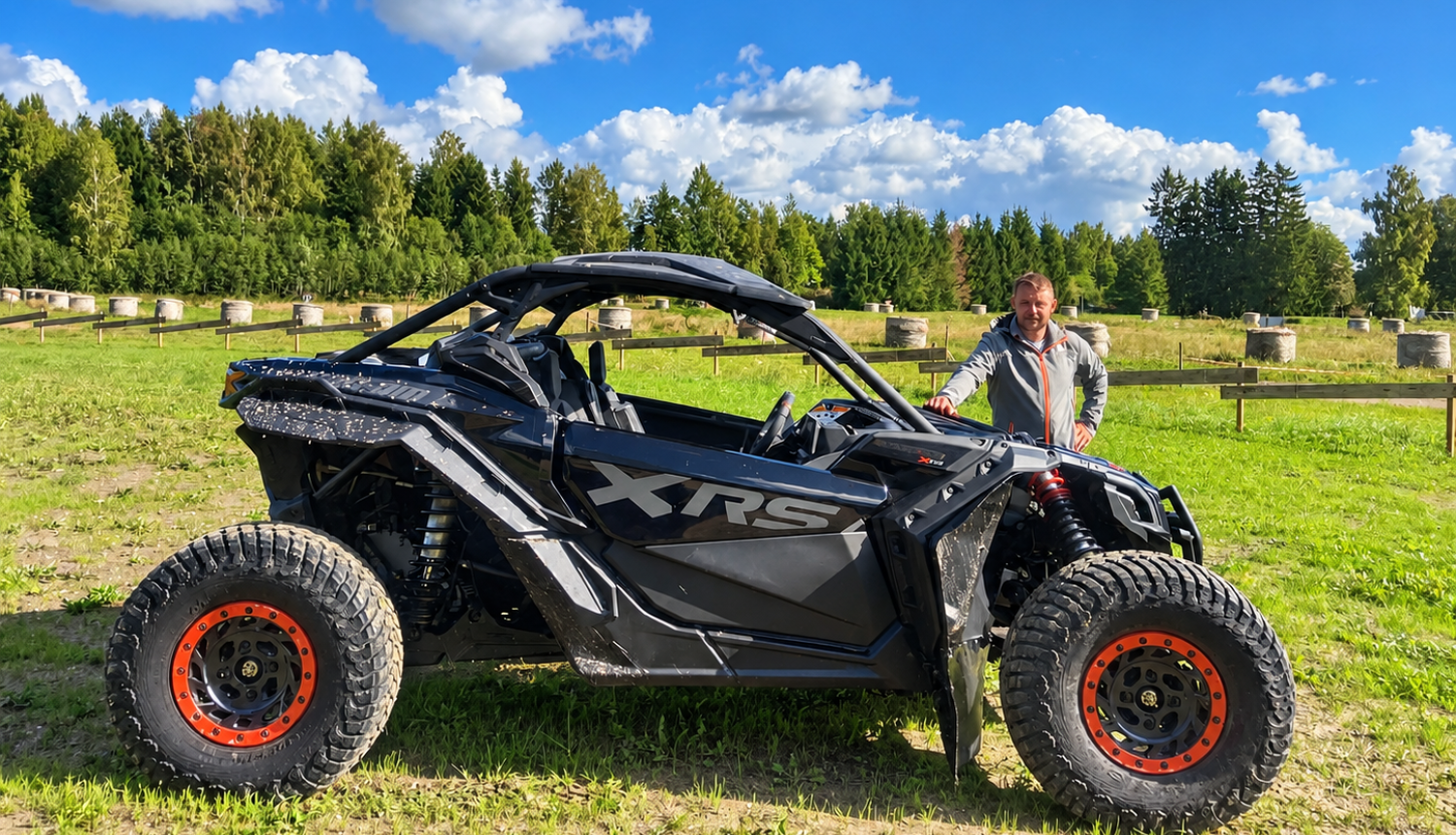
For the Kirmuška family, entrepreneurship did not stop with earthworks. The family had a property in Skulte Parish, where the idea emerged to create a place for active recreation. This time, Lāsma used business support for returnees to help bring their shared business idea to life by purchasing two powerful Can-Am Maverick buggies.
This marked the beginning of another branch of the family business: a buggy track.
“Each of them has around 200 horsepower. As far as I understand, we are the only ones in the Baltics who let people drive buggies like these,” says Ilvars.
Of course, purchasing the buggies was only the beginning. A track and the necessary infrastructure had to be developed, along with safety procedures and a system for organising the rides. Marshals supervise activities on the track, and drivers must follow specific safety requirements.
Today, the track attracts individual visitors, groups of friends and corporate groups. One corporate event brought together around 30 people, who spent almost the entire day at the track.
Ilvars takes a pragmatic view of business development. Even a good offer does not become widely known overnight.
“It is the same with every business. The beginning is the beginning. It takes time for people to hear about it, understand what it is and find out where they can come and try it. We are moving forward gradually, and we cannot complain.”
“Those Are Exactly the People We Need Back”
Life abroad gave Ilvars valuable business experience and strengthened his belief that people who are willing to work and take responsibility can find their place in Latvia as well.
At the same time, he acknowledges that not everyone is born to be an entrepreneur, and returning to Latvia does not mean that everyone has to start their own business. For people with highly specialised professions, finding suitable work in Latvia may be more difficult. At the same time, the labour market has changed, remote work is possible in many fields, and people can develop additional skills or learn something new when necessary.
From an entrepreneur’s perspective, Ilvars also sees another side of the issue. Latvia lacks people who are willing and able to do practical, hands-on work.
“It is very difficult to find people who genuinely want to work. I have spoken to other business owners, and they face exactly the same problems. In earthworks and machinery operation, there is a shortage of people. Many have left the country. Those are exactly the people we need back.”
The Door to Scotland Remained Open
Perhaps one particular thought made the Kirmuška family’s decision easier: returning to Latvia did not have to be seen as an irreversible step.
When Ilvars left Scotland, he deliberately kept open the possibility of returning one day.
“I left with the door still open because I know that if I ever need to, I can always go back.”
For now, however, there has been no need to do so.
In the Skulte area, the family now has their home and two growing areas of business. The experience gained during 17 years abroad did not stay behind in Scotland. Ilvars brought it back with him and is now putting it to use here in Latvia.
For those living abroad and considering a return, Ilvars has a simple message: there is no need to wait until you are completely certain that everything will work out.
“I would recommend coming back and giving it a try. Things here have changed for the better. Of course, everyone’s situation is different, but you have to dare to take that step. And you can always go back if you need to.”
For Ilvars, what was originally meant to be a one-year experience abroad turned into 17 years away from Latvia. Today, however, that experience has become the foundation for a new life and new business ventures in Vidzeme.
And when asked whether returning was the right decision, Ilvars does not need long to find his answer:
“It’s good here.”