



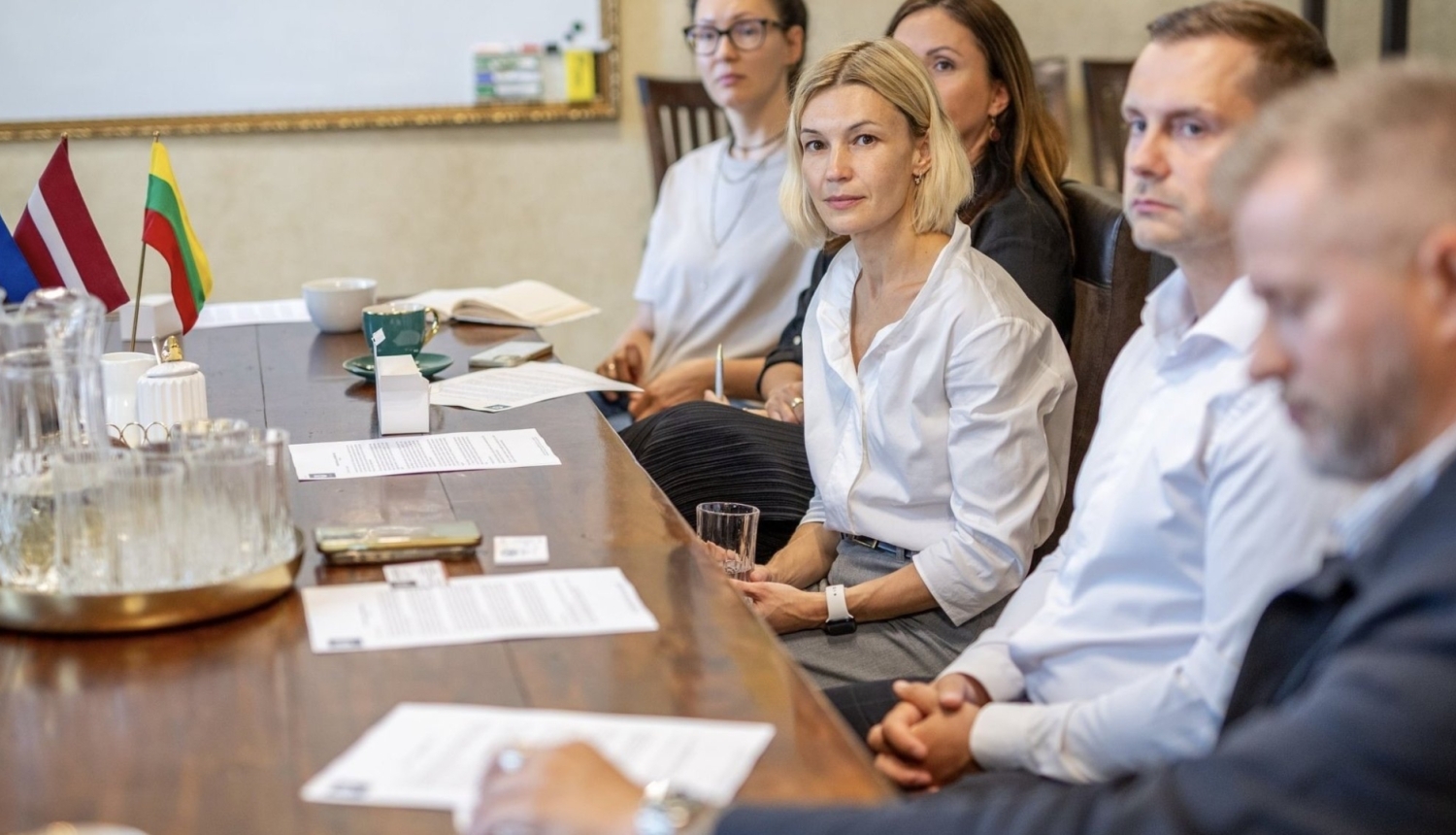
Empathetic communication allows us to hear even what remains unspoken – this is the view of international law and arbitration lawyer, law lecturer and former career diplomat Viktoriia Pochtare. From working in Latvia’s diplomatic service to passing the bar exam in New York, she proves that professional and personal growth does not necessarily mean giving up the experience we have gained along the way – we carry it with us as an inner wealth.
You speak six languages. It is not often that you meet someone who speaks so many. Which languages do you speak, and how did you come to learn each of them?
I speak Latvian, English, Ukrainian and Russian fluently, as well as Spanish and French at a more modest level. For me, languages are not merely tools for communication or professional interaction. Each one is connected to a particular stage of my life, a place and the people I met along the way.
I grew up in Daugavpils in a Ukrainian family of engineers. We spoke Ukrainian at home, while education at my secondary school was primarily in Russian, and Russian was also the main language spoken throughout the city. I spent almost every summer with my grandparents in Ukraine and later worked for four years at the Embassy of Latvia in Kyiv, where I also studied international law and international relations at Taras Shevchenko National University of Kyiv. As a result, Ukrainian also became one of my professional working languages.
I studied Latvian at school almost every day, but I only began speaking it truly fluently after moving to Riga. While studying at the Latvian Academy of Culture, reading Homer’s Odyssey in Latvian was quite a serious exercise. When I started working at the Ministry of Foreign Affairs, Latvian became my main working language.
I began studying English at school in the first grade, and I was very fortunate to have a teacher who encouraged us to read books and even poetry in English. I participated in debate clubs and public speaking competitions. Later, I continued to develop my English skills through my professional work. Today, English has become my main language for both work and everyday communication.
Immediately after graduating from university, I worked for a year at a translation agency in Riga, preparing translations for EU institutions. I learned Spanish while studying at the Latvian Academy of Culture and later in Spain. French, on the other hand, is like the youngest child in a family – it has received less attention, but I hope to make up for that injustice someday. Working at the Latvian Ministry of Foreign Affairs gave me the opportunity to use all these languages in practice when communicating with diplomats and colleagues from around the world.
You mentioned that languages are more than just the ability to communicate. How has this influenced the way you think?
Languages are not simply different words for the same things – each language carries with it a particular culture, way of thinking and sense of humour. Being able to speak to people in their native language allows you not only to understand what is being said, but also to perceive what remains between the lines. This is particularly important in diplomacy, international relations and law, where a single word can carry enormous significance.
Knowing different languages has taught me to listen more carefully and not rush to conclusions. It allows me to compare how the same events are presented in different information and cultural environments, helping me think critically and recognise the extent to which our view of the world is shaped by the environment in which we live.
I have also always been fascinated by the patterns hidden within languages – in grammar, word origins and the connections between languages. These similarities often reveal the shared history of peoples, centuries of interaction and the mutual influence of different cultures.
“They remind us that despite differences between countries and cultures, different peoples have far more in common than might initially seem.”
How did growing up in Daugavpils in a Ukrainian family shape your sense of belonging to a particular culture? And your understanding of what it means to be Latvian?
That is a very profound question. I think I understood already as a child that a person can have several cultural identities that do not exclude one another, but rather complement each other. Of course, at times this can create an inner conflict as you try to understand whether you are Latvian, Ukrainian or, now, American.
Our environment also influences our values. My childhood coincided with a period of major historical change: I was born in the Soviet Union but came of age in an independent Latvia. This made me realise relatively early that freedom, national independence and personal identity are not things that can be taken for granted or assumed to be permanent. They are values that must be cared for every day and by every generation.
Living between several languages and cultures taught me to look at the world from different perspectives. Perhaps that is precisely why I chose to work in diplomacy and international law – I have always been interested in how people with very different opinions, experiences and cultural values can nevertheless find common ground. Here, we are not talking only about language itself, but about interaction between different systems of values.
How did you feel when you first moved to Ukraine?
It was a coincidence that, a year after graduating from university, I started working at the Ministry of Foreign Affairs, and my first posting was at the Embassy of Latvia in Kyiv. It was an important stage of my life that made me reflect on my identity – I was a bridge between Latvia and Ukraine. It was also during this period that I enrolled in the Faculty of Law at Taras Shevchenko National University of Kyiv.
Living and working in Kyiv was completely different from my childhood experiences, when I simply spent time with my grandparents. When we live abroad for longer than a week and are no longer tourists but work professionally, it becomes a completely different experience. This is particularly evident in diplomatic work, because your task is to follow the most important political and economic developments, assess them critically and inform your country about them. It teaches you to look beyond headlines, distinguish facts from impressions and try to understand the deeper causes of events.
The most valuable personal benefit was the confidence that I was capable of building a life in an unfamiliar environment – communicating in another language on a daily basis, navigating local institutions, building my own social circle and earning a degree from a local university.
What was it like returning to Latvia after being away for a longer period?
I travelled to Latvia almost every month, so I was not disconnected from what was happening in Latvia, and I also communicated with my colleagues in Riga on a daily basis. In Kyiv, I also lived in a Latvian environment because I worked at the embassy – in a sense, on Latvian territory.
Nevertheless, during that time both Latvia and I had changed. When we live abroad, we look at our homeland from the outside, and this helps us see both its strengths and the things that could be improved. Of course, our perspective is always subjective, because we are human beings.
How did you decide to move to New York?
It was the next stage of my diplomatic career – working at Latvia’s Permanent Mission to the United Nations. The UN headquarters in New York is regarded as a centre of global diplomacy, so professionally it was a very important stage for me. Since I had already lived in Ukraine and Spain, moving abroad no longer seemed as intimidating. However, the scale, pace of life and diversity of New York were, of course, extremely impressive – even shocking.
Arriving in a new country begins at a practical level – finding shops where you can buy products closer to the flavours you are used to in Latvia, learning to navigate the city’s subway system and getting used to the tipping culture. The constant noise, small apartments and American units of measurement – all of these things take some getting used to. People may compliment your shoes, tell you their life story and then disappear at the next subway stop. Communication is completely different.
Professionally, it was a unique opportunity to see international law and diplomacy in action, because the UN is where almost all the countries of the world come together, each with its own history, interests and understanding of justice or how matters should be resolved. It also taught me to defend Latvia’s position while seeking common ground with negotiating partners whose perspectives could be completely different from my own.
Why did you return to Latvia after New York?
Three years is the standard term of assignment for Latvian diplomats, and I returned to work in the international law division of the Legal Department of the Ministry of Foreign Affairs. After New York, Latvia seemed very peaceful and manageable, and it was pleasant to be back in an environment where things happen easily, quickly and understandably. In New York, things are completely different because every day brings a new challenge – both in a positive and a negative sense.
Latvia offers a very comfortable environment, something Latvians themselves often fail to appreciate. Everyday life is relatively efficient: you do not have to spend a great deal of time travelling to central Riga, communication with government institutions is relatively easy and fast, and you can even get a passport within two days. There is less bureaucracy than in many other countries.
What significant differences did you notice between Latvians and Americans?
It is difficult to answer questions in such general terms. Latvians in Riga, Latvians in Madona and Latvians in Liepāja are different, just as Americans in New York or California are very different from Americans in Ohio. As a lawyer, I prefer answering specific and concrete questions. (Laughs.)
Americans tend to be more open, optimistic and friendly, while Latvians are generally more reserved and less demonstrative. However, once mutual trust is established, Latvians often develop deeper relationships.
There is some truth in stereotypes, and they can sometimes be useful, but everything depends on the people we spend our everyday lives with, so I am not sure how objective any individual observation can be. I work with lawyers every day, so my perception of Americans is based on the people I interact with in my daily life. The same was true in Latvia, where I worked at the ministry and with the government.
Why did you decide to return to New York?
My husband works for the United Nations, so our family life is closely connected to New York, but I also had professional reasons. I wanted to continue my legal education and find out whether I could apply my international experience in the American professional environment. However, I quickly realised that my Latvian and Ukrainian education alone would not be enough to establish myself professionally in New York.
I realised that I needed a local degree, so I enrolled at New York University School of Law (NYU School of Law), one of the world’s leading law schools. Later, I also passed the New York State bar exam and obtained the right to practise law in the State of New York.
Professionally, I had to start many things from scratch: learn a new legal system, which differs from those of Latvia and Ukraine, build a new professional network and adapt to a new communication culture. Nevertheless, the challenge was extremely valuable because it proved that starting over does not mean starting from zero. We always carry our experience with us and can put it to practical use.
“Life is short, but it is also long enough to change direction at any point.”
What are you currently doing professionally in New York?
I work in private practice and specialise in international law, investment law and commercial law. Part of my work involves international dispute resolution, or arbitration, where disputes between states and foreign investors, as well as between companies from different countries, are resolved.
Alongside this, I teach international law and legal research at St. John’s University in New York. For the past three years, I have chaired the International Law Committee of the New York City Bar Association. Although this is voluntary work, it is very rewarding and helps me build professional connections.
At the same time, I continue to strengthen my professional ties with Latvia. As a representative of the Latvian Chamber of Commerce and Industry in the United States and Regional Co-Director of the Latvian-American Chamber of Commerce, I advise Latvian companies seeking to enter the US market or expand their operations there.
How do you view Latvians’ self-confidence and courage to venture out into the wider world?
That is indeed a philosophical question. I do not think Latvians lack either ability or courage, so I do not believe that much needs to be changed in terms of our value system – those values are good and important. What we need to change is our marketing, and by that I mean not only advertising, but also the ability to clearly and convincingly communicate our value.
We have excellent companies, products, technologies and professionals, but in an international environment – and in a market as large as the United States – quality alone is not enough. We need to be able to explain what makes a particular offering special, what problem it solves and why a partner or investor should choose Latvia.
The same applies to the country as a whole.
“We need a clearer and more unified story about who we are. Not only a green country rich in cultural traditions, but also a reliable, innovative and secure partner in business, technology and other fields.”
We need to be confident and consistently build our image, and this is where the diaspora can play a major role. We can be a resource for growth, bringing knowledge, connections, reputation and an understanding of foreign markets.
The project “Working for Latvia – Sharing Diaspora Stories and Current Affairs in Latvia” is co-financed by the Media Support Foundation from the state budget of the Republic of Latvia. The content of the publication is the responsibility of “Latviesi.com”. #SIF_MAF2026