



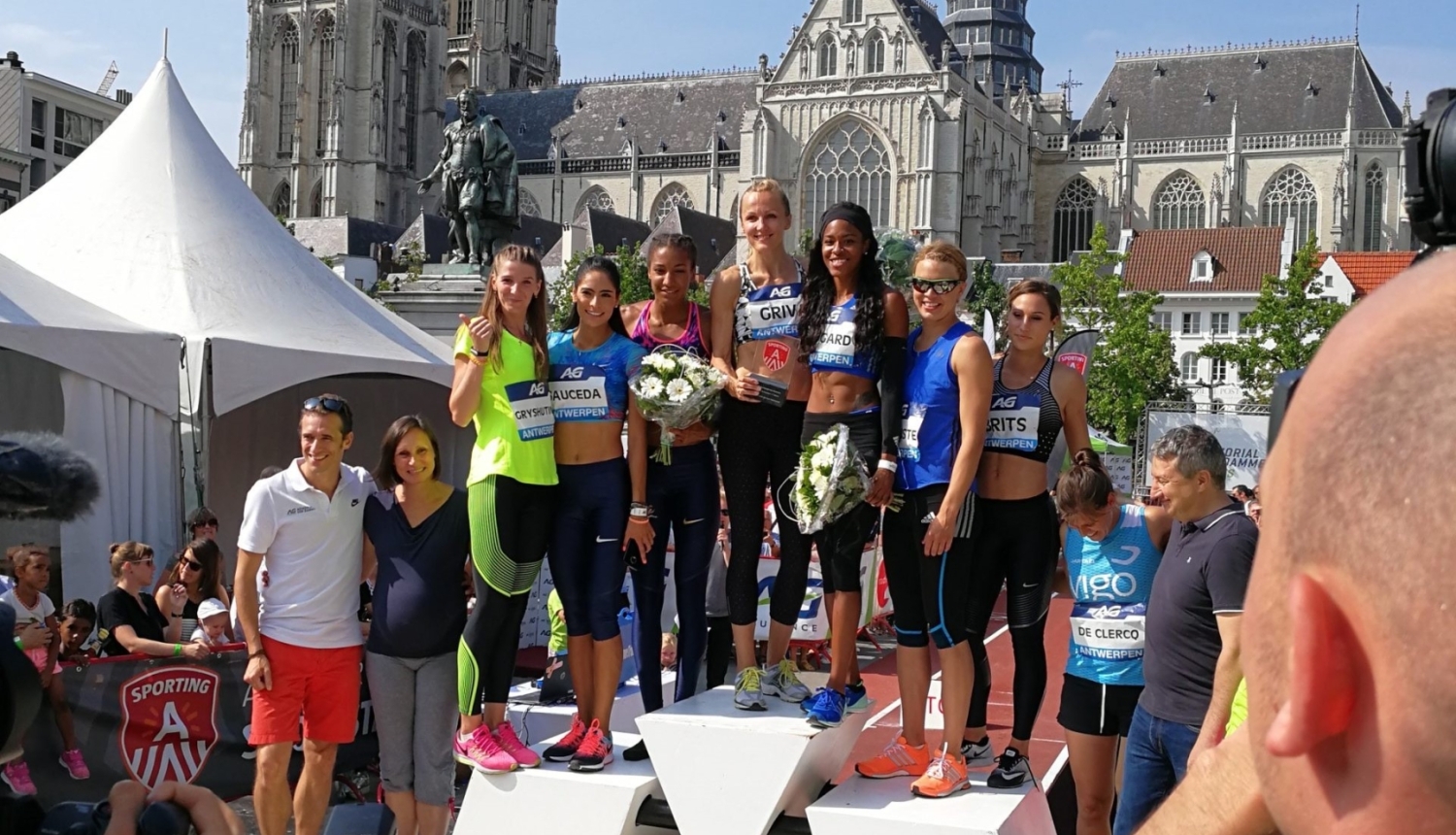
Lauma Grīva is from Ventspils, an Olympian, a finalist at World and European Championships, a multiple Latvian long jump champion, a coach, a mother of three, and one of the co-founders of the Kabile Manor Winery. She also once created and managed the healthy food bar “LAPU”, demonstrating her interest in a healthy lifestyle and her desire to inspire others through her knowledge and experience.
Her life path has taken her to many parts of the world — training camps, high-level competitions, and also a longer period of living in Italy. Lauma has seen the world, experienced the heights of professional sport, and come to know life outside Latvia. However, when the time came to choose where to build her life, raise her children, and continue her work in sport, Lauma chose to return to her homeland — Latvia, and to her beloved Kurzeme by the sea.
“Sometimes, perhaps, you have to go far away to truly understand where your home is,” says Lauma Grīva.
The decision that changed with the birth of a child
Professional sport gave Lauma an invaluable opportunity to discover the world, train at a high level, and achieve goals she could only have dreamed of as a child. She spent more than four and a half years outside Latvia, almost two of them in Italy.
It was a country with a sunny climate, excellent food, and a rhythm of life well suited to an athlete.
“At that time, it felt like I had found my true place in the world,” she recalls.
But in life, there are moments that change the way we see things. For Lauma, that moment was the birth of her son.
For the first time, she asked herself completely honestly:
“Where do I want my child to grow up? What values do I want to pass on to him? What kind of childhood do I want to give him?”
The answer was clear — Latvia.
Lauma realised that she wanted her children to grow up close to their family — among grandparents, aunts, uncles, cousins — discovering their roots and feeling a sense of belonging to their land.
Over time, the things that had seemed self-evident while living in Latvia returned to her memory more and more vividly — the scent of pine forests, the sea air, and the feeling that within just a few minutes you can reach a stadium, a forest, or the seashore.
“Living in Italy, even just to go for a walk in nature, you often had to drive twenty or thirty minutes. In Latvia, we often do not even realise how incredibly accessible nature, the city, and the sea are to us,” says Lauma.
Sometimes it is distance that helps us see the true value of what once seemed ordinary.
Ventspils, the sea, and the irony of fate
For Lauma, returning to Latvia meant returning to a specific living environment — Kurzeme and the Ventspils area, where the sea and forests are close by, where sports infrastructure, a music school, and extracurricular education opportunities are available, and where the environment is well organised and suitable for children.
Looking back on her choice, Lauma smiles at life’s ability to surprise.
“When I moved to Riga at the age of eighteen, I loudly declared that I would never, ever live in a small town,” she laughs. “And look how life arranged everything — now I live in a homestead right by the sea! I found my place in Kurzeme. It is a bit like the story of Sprīdītis — after weighing all the pros and cons, the choice was clearly in favour of Latvia. Although I still love travelling.”
Life can surprise us. Places we want to leave when we are young can, over the years, become the places where we find peace, strength, and a sense of belonging.
For Lauma, that place is Kurzeme.
The sea, the forest, the open space, and the feeling — I am home!
Returning means starting anew
Returning was a decision that required courage. When Lauma came back to Latvia, she had modest savings, ideas, and the belief that it was possible to build a life through her own efforts. At first, the family lived with her parents. Alongside her professional sports career, Lauma, together with her sister Māra and her friend Agate’s family, began developing the Kabile Manor Winery.
It was a new chapter in life, with many unknowns ahead. There was work to be done, decisions to be made, and challenges to face, but they were accompanied by the courage to try, the willingness to take risks, and faith in herself. It was here that the qualities gained through sport became a major source of support in everyday life as well — discipline, patience, the ability to make decisions, and the strength to keep moving forward even when the result is not yet visible.
“A life path, just like a sports career, rarely follows a straight line. Sometimes it goes upward. Sometimes it makes you stop for a moment. And sometimes it requires you to change direction in order to continue the journey,” Lauma adds.
Sport as a school of life
This enterprise and resilience are also rooted in Lauma’s family. She grew up in a large, athletic family of five children — Lauma has two sisters and two brothers, with whom she still shares very close relationships. Her father, the legendary javelin coach Māris Grīva, taught her a life lesson worth its weight in gold:
“The winner is not the one who never falls, but the one who is always able to get back up.”
These words have taken on special meaning in Lauma’s life. From the outside, professional sport often looks glamorous — medals, applause, the excitement of competition, and moments of victory. But behind every result are countless hours of training, fatigue, doubt, setbacks, and moments when the body demands a pause.
On an athlete’s path, injuries happen — disrupting the usual rhythm and forcing one to learn to trust one’s body all over again. Recovery requires patience, discipline, and psychological resilience. It is especially difficult when the mind already wants to return to the rhythm of competition, but the body still needs time.
It is precisely in such moments that sport becomes a school of character. One must learn to listen to oneself, accept that recovery is also part of the training process, and understand that sometimes a step forward begins with the ability to slow down for a while.
Lauma knows this experience well. Her path has included both major achievements and difficult periods when she had to find the strength to continue — a serious back injury, fractures, and financial difficulties. But it is precisely such moments that teach a person a great deal — including the fact that a person’s strength is defined by how they pass through challenges and what they take from them.
“Sport taught me to be stronger in life as well,” Lauma admits.
That is one of the greatest values of sport. Sport teaches us to accept defeat, wait for our moment, and start again from the beginning. It teaches us that one failure does not erase everything achieved so far. Medals remain on shelves, results are eventually surpassed, and applause fades. But what a person learns on the way to their result stays with them for life.
A new mission — investing in the future
Today, Lauma passes on this experience, strength, and love of sport to others. By coaching children in athletics and general physical fitness, helping adults become stronger, and serving on the board of the Latvian Athletics Association, she is investing in the next generation.
Perhaps one of the children she teaches today to run, jump, and believe in their abilities will one day become a champion. But the journey itself is just as important — discipline, patience, responsibility, and the ability to accept failure and continue.
Everyone faces their own hurdle in life. And if sport has taught them to overcome it, that is already a victory. Modern sports and health science confirms the importance of regular physical activity for a person’s physical and psychological health. Movement helps maintain cardiovascular health, strengthen muscles and bones, improve wellbeing, and build healthy everyday habits. For children and young people, physical activity is especially important for healthy development and the formation of long-term habits.
But the value of sport extends beyond physiology. It teaches us how to live. It teaches us to wait. It teaches us to try again. It teaches us to get back up.
The greatest dream — to return
Looking back on her journey so far, Lauma says:
“Sometimes the greatest dream is not to leave, but to return.”
There is much more in these words than a decision to change one’s place of residence. It is a choice about belonging, family, the environment in which we want to see our children grow, and the land to which we want to give back what we ourselves have received from it.
Lauma’s story reminds us that the world is wide, and it is worth discovering. It is worth leaving, searching, learning, and achieving. But there is also a special strength in the ability to return — with experience, knowledge, a new perspective, and the desire to give something back to one’s land.
Lauma Grīva’s story is about sport, family, courage, hardship, and choice. It is about a woman who has seen the world, experienced both the brilliance and the shadows of professional sport, faced challenges, and nevertheless found her way back to the place where she feels she belongs. To her people. To the sea. To her land. To home.
“Perhaps the longest jump in life is not the one measured in centimetres. Perhaps the longest jump is the courage to fly out into the world, see its vastness, and then choose, with a full heart, to return home.”
If you do not know where to start
You, too, may have your own story of returning. Perhaps the thought of living in Latvia has been present for some time, but it is still not clear where to begin, where to look for information, or how to resolve practical matters.
At such a moment, the most important thing is to take the first step. Practical support is also available on the path of return. There are people who will listen, help you understand your options, and work together with you to find the most suitable solutions.
“I am grateful to the people who are there and help in moments when you do not yet have all the answers yourself. You do not need to know everything at once. There are people who will listen to you, appreciate your courage, and help you take the next step. I also thank my remigration coordinator Agnese Berģe,” says Lauma.
Returning begins with a decision. Sometimes — with one question, one phone call, or one conversation with a person who knows where to look for help. You do not need to know all the answers. The wish to begin is enough.

About the work of remigration coordinators
If you have questions and need support in returning to your homeland, we invite you to contact a remigration coordinator. After identifying your needs, and in cooperation with municipalities or other state institutions, the coordinator prepares an individual offer.
A remigration coordinator can provide support on services for families, housing matters, employment and entrepreneurship opportunities, and the resolution of social and everyday practical issues.
More information about the services provided by coordinators is available at: https://www.remigracija.lv. More information about remigration in Kurzeme is available in the remigration section of the Kurzeme Planning Region website: www.kurzemesregions.lv/remigracija, where you can also read about the experiences of other remigrants returning to Latvia.
Information prepared by:
Kurzeme Regional Remigration Coordinator
Agnese Berģe