



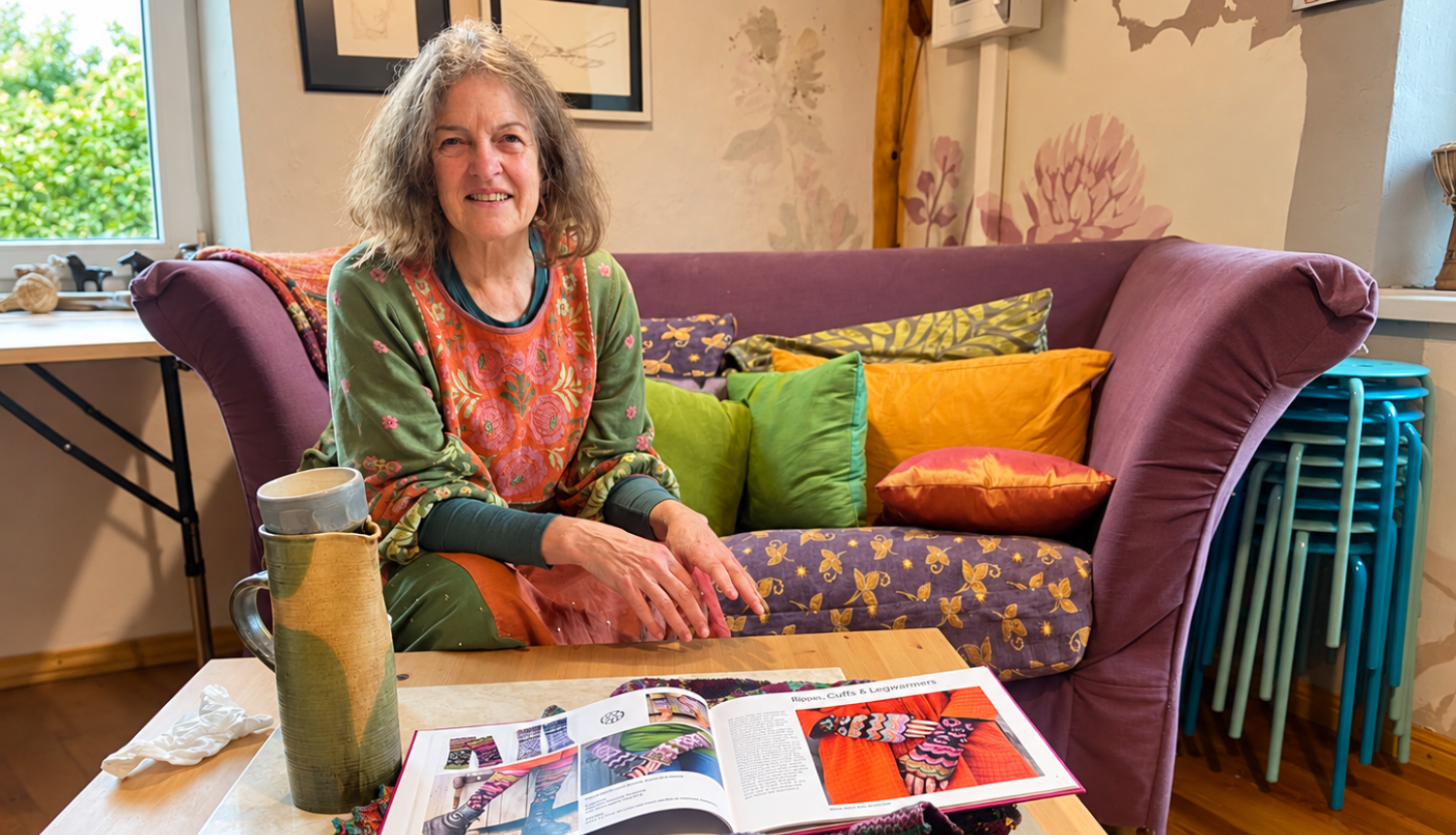
There are places we discover by chance, and there are places we seem destined to return to. For knitwear designer Inese Īris Liepiņa, Piebalga is one of those places. Although she was born and spent much of her life in the United States, Latvia has always been present in her family's story, language and traditions. More than twenty years ago, Inese decided to move to her ancestral homeland, eventually choosing a rural property near Vecpiebalga as her home. Today, she has found something there that she believes money cannot buy: a sense of belonging, peace, support from those around her and the opportunity to live according to her values.
Latvia Has Always Been Part of Her Life
Inese was born in the United States into a Latvian family. The lives of her parents and grandparents were deeply affected by events in Latvia's history. War and the threat of political persecution forced the family to leave their homeland. One of her grandfathers had worked as a teacher in Taurene, but historical upheavals forced him to leave Piebalga.
Although Inese grew up far from Latvia, Latvian culture was never unfamiliar to her. She attended Latvian school, sang in a choir, participated in the Latvian Girl Guides movement and learned traditional crafts. The Latvian language and culture were a natural part of her everyday life.
Inese explains that her Latvian still contains some older expressions, as her language developed within the Latvian diaspora community. Yet it was precisely this community that helped maintain her connection to Latvia at a time when the country itself was on the other side of the ocean.
For Inese, returning to Latvia means much more than simply moving to another country. Her family's roots in Piebalga stretch back several generations, so living here is also a way of continuing her family's history.
Choosing Quality of Life
In America, Inese had built a professional career in fashion design. She lived in San Francisco, worked for design companies and managed design departments. However, her professional life was unstable, jobs changed frequently and her income was insufficient to cover everyday expenses. Her financial difficulties continued to grow, and she gradually fell into debt. After separating from her husband, Inese realised that she could no longer afford to live in San Francisco on her own.
After moving to Latvia, Inese initially continued working remotely as a freelancer for her former textile design company. During her first year, she earned a very good income. Later, however, comparing life in the two countries, she realised that even with an income approximately five times lower than in America, it was possible to enjoy a more fulfilling life in Latvia. Everyday expenses were lower, and opportunities to enjoy life became more accessible.
As an example, Inese mentions going to the opera. In America, tickets had been so expensive that she could not afford to attend performances, whereas in Latvia, opera became an accessible cultural experience. On one occasion, she and a friend even went to a performance specifically to admire the costumes, as both shared a professional interest in costume design.
Inese's belief is simple: quality of life is not determined by the size of one's salary. What matters much more is having opportunities to enjoy life, gain new experiences and do things that bring happiness. Equally important is feeling that you belong in the place where you live.
A Home That Seemed to Be Waiting for Her
Inese searched for her rural property in Piebalga together with a friend who knew the area well. They made several trips to view different houses, but one particular property kept catching Inese's attention.
Initially, she had not chosen it, yet her curiosity and desire to see the place never disappeared. When she finally managed to visit, she had a feeling that this was exactly where she was meant to be.
The house required considerable improvements. Heating was particularly challenging, as it was difficult to keep the rooms sufficiently warm during winter. When the time came to rebuild the tiled stove, an unexpected discovery was made: old stove tiles had been preserved in a nearby shed and proved useful for the restoration work.
Inese remembers this experience with particular warmth. For her, it became another sign that she had chosen the right place.
Of course, rural life also comes with practical challenges. In winter, roads can become difficult to navigate, so she has had to adapt and purchase a more suitable vehicle. Inese tries to be prepared for periods when heavy snow might prevent her from travelling to the shop.
There is a garden beside her house where she grows some of the food she needs for everyday life. She has also recently acquired a small cellar and a sauna. Home-grown vegetables and the rhythm of rural life help reduce daily expenses, while the sauna represents a long-held dream that has finally come true.
Neighbours You Can Rely On
One of the greatest treasures Inese has found in Piebalga is its people. Although houses may be several kilometres apart, relationships between neighbours are close.
When Inese first moved into her property, there were few permanent residents in the surrounding area. Gradually, more people settled in nearby houses, creating a small community of mutual support.
These relationships became especially evident when Inese unexpectedly needed medical assistance and was taken to hospital. Before she had even arrived, her neighbours were already calling to find out what had happened and how they could help. They offered to look after her pets, keep an eye on her house, light the stove and, if necessary, bring her home from hospital.
This experience made her reflect on how important it is for people to look out for one another in everyday life. This is particularly true in rural areas, where close relatives often live in other towns and cannot always arrive quickly in an emergency.
Inese acknowledges that people in her neighbourhood are independent and are not accustomed to asking for help. Over time, however, everyone has come to understand that sometimes a simple phone call or checking in on someone can provide much-needed support.
It is precisely these relationships that give her a sense of security and belonging. The peace and quiet of rural life does not have to mean loneliness when there are people nearby who genuinely care about their neighbours.
Knitting as a Profession and Creative Freedom
Alongside rural life, knitting plays an important role in Inese's everyday activities. Although it might appear to be a hobby, Inese emphasises that it is her work and profession.
She has been creating and selling knitted items since the 1980s. Later, while working for design companies in America, knitting temporarily took a back seat.
Her many years of experience in the design industry gave Inese valuable professional knowledge, but also helped her understand just how important creative independence was to her. While working for large companies, she repeatedly experienced situations in which her original design ideas were gradually altered at different levels of management.
At two companies where production took place in China, local business partners even asked why Inese changed her designs so frequently when the first version had always been the best. In reality, the original design had been her own, but changes were subsequently introduced by the department manager, the company director and finally the owner. As a result, the finished design sometimes differed so significantly from her original vision that Inese no longer considered it her own work.
When she realised that she would be staying in Latvia permanently, she also made an important professional decision: she would no longer work under the management of other companies and would instead take full responsibility for her own ideas. Inese wanted to preserve the freedom to create designs exactly as she envisioned them, without subjecting them to internal company politics and constant modifications.
After moving to Latvia, Inese initially continued working remotely with her former employer, creating textile designs on a computer. However, during the global financial crisis, the company went bankrupt, and she had to look for other sources of income.
That was when Inese returned to knitting. She initially chose to make scarves, as they were a relatively affordable accessory that allowed people to refresh their wardrobes even when they had limited money to spend on new clothes.
Gradually, she created more and more pieces and began offering them to customers online and at craft markets. For many years, she travelled from Piebalga to Riga, sometimes getting up as early as four in the morning to arrive at the market on time with all her knitted products.
International visitors showed particular interest in her work, appreciating the quality of handmade woollen items.
Over time, Inese's work also developed an international dimension. Through her contacts with other professionals in the textile arts industry, she established a partnership with a yarn company that invited her to create knitwear designs incorporating traditional Latvian patterns.
In this collaboration, preserving her creative independence was particularly important. She agreed on a partnership model in which she receives the yarn needed for her work instead of monetary payment, while retaining the copyright to her designs and the right to sell the knitting patterns independently.
This collaboration required her to develop new skills, particularly writing knitting instructions, as she had previously been accustomed to working mainly from experience and intuition.
Her designs feature traditional Latvian mitten patterns, the Auseklis symbol and other traditional motifs adapted for contemporary clothing and accessories. For Inese, it is important that Latvian cultural heritage continues to live beyond museums and traditional folk costumes.
Her knitting patterns are purchased by enthusiasts in various countries, particularly in America and Norway. Through Inese's work, traditional Latvian patterns reach people who may never have visited Latvia.
Although Inese is now retired, she continues to create new designs and participate in craft markets whenever she chooses. She appreciates being able to work at her own pace, without worrying about having to earn a certain amount at every event.
Living Where You Feel You Belong
Inese's story shows that returning to Latvia is not always about greater professional opportunities or higher earnings. Sometimes, what matters most is the opportunity to live in an environment where you feel understood, accepted and at home.
Life in Latvia has given Inese the freedom to shape her own daily routine and professional path. After years spent working for large design companies, she has gained creative independence here, while Piebalga has offered her peace and people she can rely on.
For Inese, Piebalga is a place where her family's history meets the lifestyle she has chosen for herself. Here she has a home, a garden, creative work, supportive neighbours and an everyday life that leaves enough room for culture and personal interests.
After spending many years in America, Inese has no regrets about her decision. Her experience demonstrates that returning to one's ancestral homeland can become an opportunity to build a life on one's own terms, preserve independence and find fulfilment in the things that truly matter.