


Returning to Latvia after living abroad often begins with a feeling: a desire to be closer to family, the Latvian language, children’s future and a place where one feels a sense of belonging. Alongside thoughts of home, however, practical questions also arise: where to live, where children will go to school, how to find work, how to deal with the necessary paperwork and how to rebuild everyday life in Latvia.
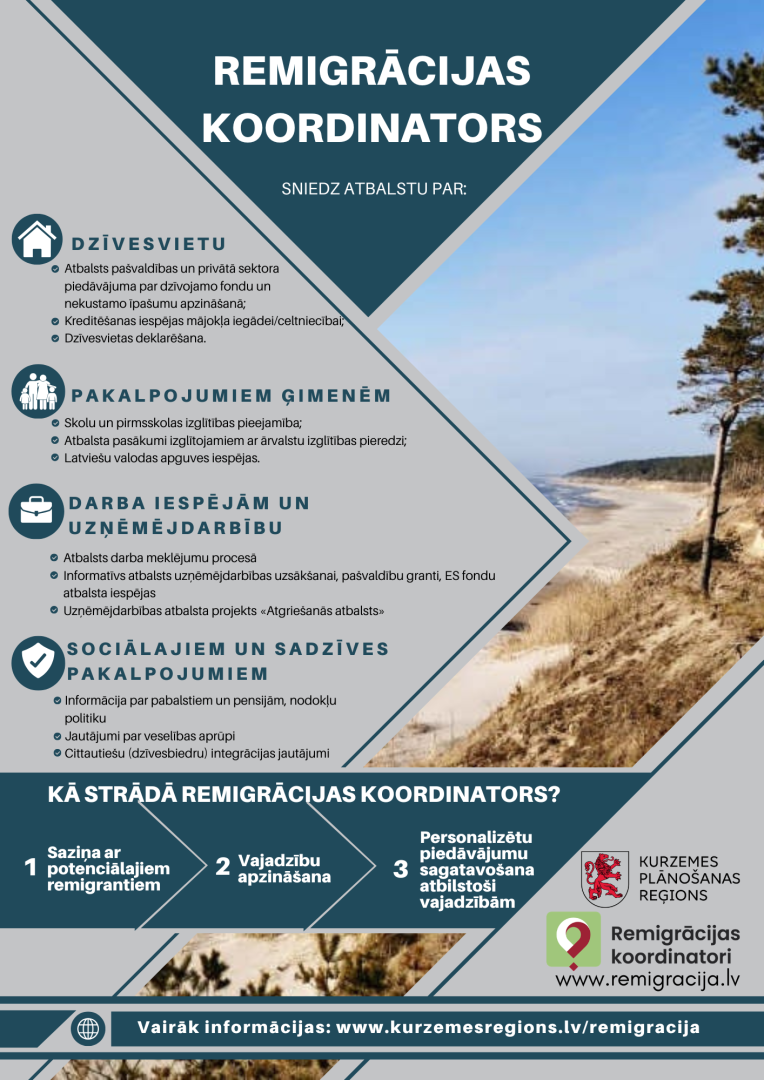
A return migration coordinator provides support with precisely these matters. As a trusted point of contact, the coordinator helps individuals and families prepare for the return process and find practical solutions in a specific region of Latvia.
In Kurzeme, this work is carried out by Agnese Berģe, Regional Return Migration Coordinator at the Kurzeme Planning Region.
“Every return story begins with thoughts of home – with a desire for change, a different pace of life, or a sense that the right time has come to return to Latvia. Practical questions then follow: housing, children’s education, employment, documents and settling into everyday life in Latvia. A return migration coordinator can offer a helping hand with these matters, because practical issues can be resolved,” says Ms Berģe.
Support Tailored to Each Family
The return migration coordinator provides free, individual consultations, helps identify each person’s needs and, in cooperation with local authorities, national institutions and other organisations, prepares personalised information suited to the circumstances of the individual or family concerned.
The coordinator can assist with housing and accommodation, employment opportunities, business development, nurseries and schools, local authority services, paperwork, social support and other practical matters.
Importantly, people can contact the return migration coordinator before returning to Latvia. This makes it possible to prepare for the change in good time and to make the relocation process clearer, calmer and better considered.
617 Families Have Returned to Kurzeme Since 2018
According to information compiled through the return migration coordination programme, 617 families, comprising 1,865 people, returned to Kurzeme after living abroad between the launch of return migration support in March 2018 and the end of June 2026.
During this period, personalised proposals were prepared for 1,845 families, comprising 5,190 people, while a further 491 families, or 1,454 people, expressed an interest in returning. The most popular places to settle in Kurzeme are Liepāja and Ventspils, as well as the municipalities of Tukums, Kuldīga and Talsi.
These figures point to sustained interest in returning to Kurzeme. Behind every number, however, are people, families and children, as well as professional experience, new ideas and personal decisions about continuing their lives in Latvia.
Why Do People Return?
A survey of return migrants conducted by the Kurzeme Planning Region in July 2026 found that decisions to return are most often driven by a sense of belonging to Latvia or one’s home area, a desire to live in Latvia, proximity to family and educational opportunities for children.
Nearly 68% of respondents cited a desire to live in Latvia and a sense of belonging to Latvia or their home area; almost 64% wished to be closer to family and relatives; and nearly 60% wanted their children to attend educational institutions in Latvia.
Among practical considerations, employment opportunities in Latvia were mentioned most often, by nearly 42% of respondents, while just over 36% referred to improvements in Latvia’s standard of living. Around a quarter cited the rising cost of living in their previous country of residence, and almost one fifth wished to start or develop a business in Latvia.
These findings show that the decision to return is usually shaped by a combination of emotional, family-related and practical considerations.
The Return Experience Is Largely Positive
The survey data show that, for most respondents, returning to Latvia has been a positive experience. Nearly 90% said that they felt happy or fairly happy after returning, while almost 80% described the practical process of settling in Latvia as easy or fairly easy.
Social integration has also gone well for most respondents: nearly 86% said that they had settled in well and were leading active lives, or were gradually settling in. Almost 70% had started employment or self-employment within six months of returning.
Children’s educational opportunities were also rated positively. Among respondents for whom this issue was relevant, nearly 88% rated educational opportunities for children in Latvia as very good, good or fairly good.
The Coordinator’s Work Is Rated Very Highly
More than 70% of survey respondents had used the support of a return migration coordinator. Of those who had used and rated the service, nearly 90% were very satisfied or fairly satisfied with the coordinator’s work. The survey recorded no negative assessments of the coordinator’s work.
Respondents most commonly received help with documents or administrative formalities, cited by nearly 90% of service users. More than 85% received information about local authority services and available support; around two thirds received information about employment and housing opportunities; and nearly two thirds received information about nurseries or schools.
Sixty per cent received practical or emotional support during the return process, while almost one fifth received information about business opportunities.
Respondents also mentioned assistance with benefits and services provided by the State Employment Agency, courses and training, the translation and recognition of documents, healthcare matters, the transport and customs clearance of personal belongings, and other practical issues specific to their circumstances.
This demonstrates that the return migration coordinator is important not only as a source of information, but also as a provider of practical and personal support throughout the return process.
“People who return bring new experience, knowledge and perspectives to Kurzeme. Our role is to stand alongside them and help make this journey clearer, easier to understand and practically achievable,” Ms Berģe emphasises.
Let Us Start with a Conversation
Those considering a return to Latvia and wishing to make Kurzeme their home are invited to contact the return migration coordinator at the Kurzeme Planning Region. The earlier the conversation begins, the easier it is to prepare for the relocation and identify the most suitable solutions.
Further information about the services and support provided by return migration coordinators is available on the central website www.remigracija.lv , which is intended for people considering a return to Latvia.
More information about return migration to Kurzeme is available on the Kurzeme Planning Region website at www.kurzemesregions.lv/remigracija and on the “Atgriežos Kurzemē” Facebook page.
About the Survey
The survey was conducted by the Kurzeme Planning Region from 2 to 13 July 2026. People included in its contact database of return migrants who had moved back to live in Kurzeme after residing abroad were invited to take part. A total of 77 respondents participated; they had returned to Latvia between 2018 and 2026. Their current places of residence cover every municipality in Kurzeme and both of the region’s state cities.
Given the respondent selection method and the number of participants, the results reflect the experiences and views of those surveyed, but should not be regarded as statistically representative of all return migrants living in Kurzeme. The survey data provide an indicative insight into respondents’ reasons for returning, their experiences and needs, and their assessment of the support received.
Further Information
Agnese Berģe — Regional Return Migration Coordinator, Kurzeme Planning Region
Telephone: +371 20478252 | Email: koordinators@kurzemesregions.lv